With just over two weeks to go before Strandfall’s first run, I want to reflect on how our game design, story, and logistics have developed, especially in response to our field tests and feedback from advisors.
Sectors
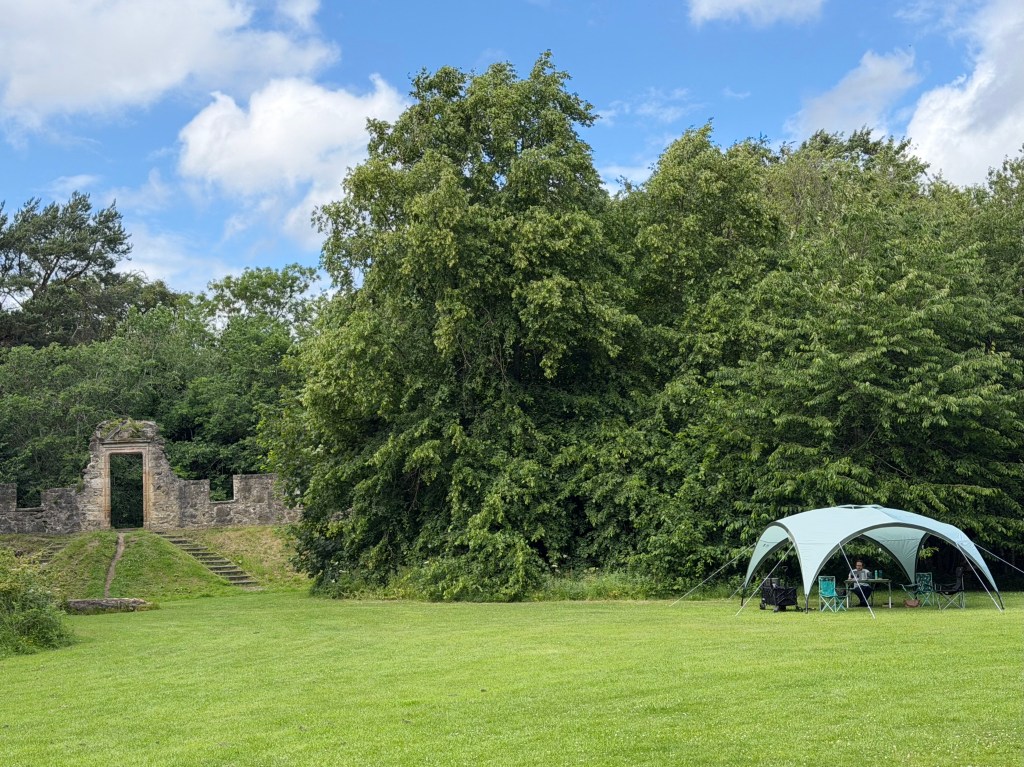
Strandfall takes place in Cammo Estate park, which is around 1.7km long and 700m wide. We’ve divided the park into eight named sectors (Nero, Epsilon, Astral, etc.) Sectors are important because a storm hits a whole sector all at once, so if you are anywhere in Orion, you need to escape to another unaffected sector to be safe.
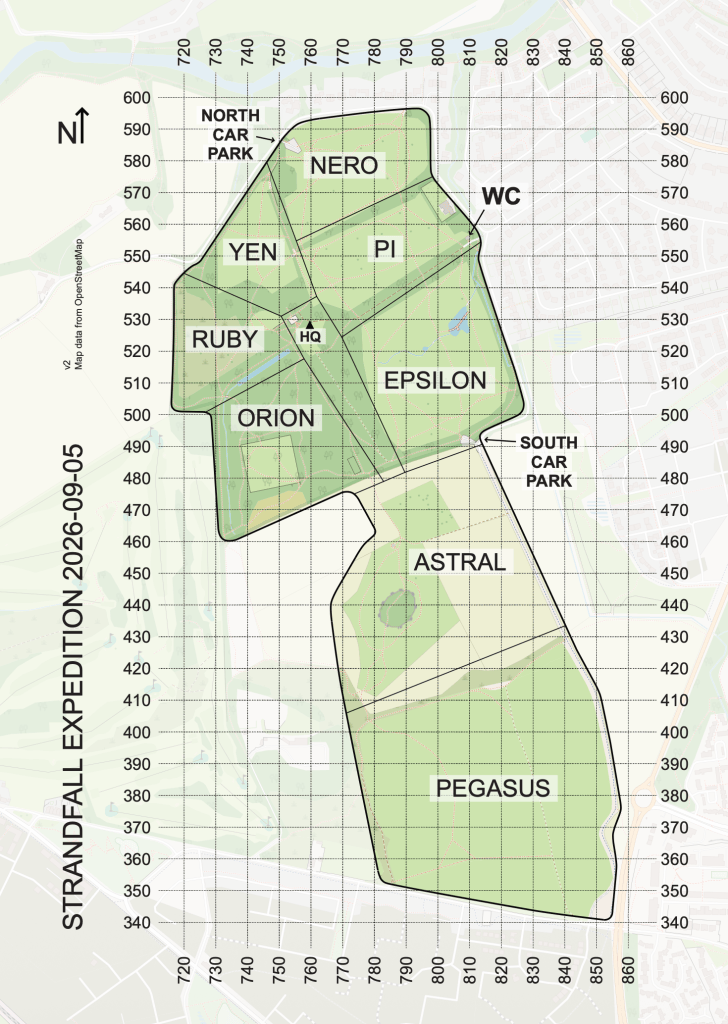
This has significant gameplay and accessibility advantages. Since sectors are bounded by major geographical features of the park like fields and paths, it’s very easy to learn where a sector begins and ends, so when a storm is approaching, you don’t need to look at your map or device – you know you just need to make it to the path in time. Similarly, if you want to forecast storms, you can do that from anywhere within a sector. That makes it possible to choose your own way in and out rather than following a precise, pre-determined route.
This isn’t to say that it doesn’t matter at all exactly where you are in the park. There are some elements of gameplay that require more precise positioning, including your relative position to other players. Even then, however, there’s a reasonable amount of leeway.
The sectors next to HQ are smaller and packed tighter, whereas those further to the south are much bigger. This is partly a consequence of the actual geography of Cammo Estate, but it’s also our conscious choice to balance difficulty. People who aren’t able to walk or run far can focus on the sectors next to the HQ, while others can venture further south. Because those sectors have more uneven terrain and there are fewer paths, we’re giving players more options on where to move within them.
(In fact, we shrank the play area halfway through the design process after I scouted out one area in the south and found it much rougher and overgrown than it had appeared in satellite maps. There really is no replacement for checking things out in person.)
Onboarding
I’ve always found it oddly satisfying to distill a messy, half-formed game design into a clean set of instructions. As many have noted, you don’t know if you really understand something until you try explaining it to a beginner.
To that end, Strandfall’s 4000-word onboarding document, while primarily written as a script for me to read out when players arrive at the park (along with hands-on demos and Q&As), is also meant to be fully comprehensible by players reading it in advance, on their own.
We’ve been very clear that players aren’t expected to read it: that’s what the in-person onboarding is for. But some players find it reassuring to know the shape of the experience in advance, and it helps everyone – including the organisers – if there are multiple people who can answer questions about the game design.
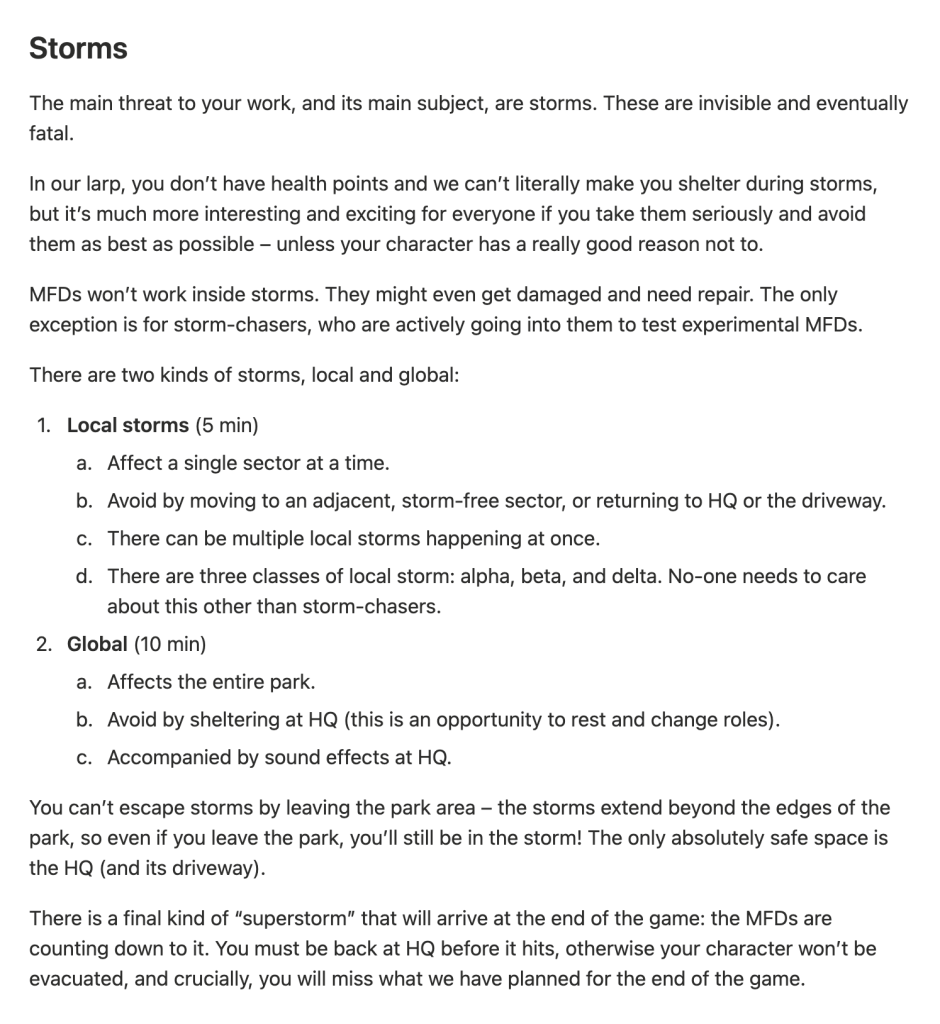
I’m not going to share the whole document here because it might still change, but here’s an excerpt:
Most immersive art doesn’t provide this level of detail to participants, whether in advance or on the day. Usually it’s viewed as boring homework that impedes accessibility, or as an obstacle to immersion. How can people have a genuine, authentic experience if they know what might happen in advance?
Without getting into all the intricacies of these arguments, the case for explaining things in advance is pretty simple: if you want to give participants agency within an fictional experience, it’s helpful for them to know how that agency can be exercised. In our case, our players are researchers in a post-apocalyptic world. They really ought to know what they’re studying and how their equipment works, and attempting to explain these things diegetically can take even longer and generate more confusion than simply telling people upfront.
That doesn’t relieve larp designers of the responsibility to explain things concisely and engagingly. We can probably agree that instructions on how to use crucial in-game tools is essential. Most players, however, won’t read a 30,000-word encyclopaedia of the world and lore of Strandfall, and the few that did would be met with puzzlement if they tried referring to its facts in-game.
This is not to say that individual players wouldn’t gain any benefit from reading it, if only to inform their private, internal experience, but the effort of writing those 30,000 words might be more fruitfully directed to the production of a smaller, more engaging set of shared knowledge that players could count on everyone knowing, thereby informing and enriching everyone’s experience.
Weird sci-fi
After writing some draft story, Juhana Pettersson (our Nordic larp design consultant) noted that we were playing Strandfall very “straight”. Not in a bad way, but more as an observation that our sci-fi world wasn’t especially magical or fantastical. A few weeks later at a field test, I trialled a “psychometric assessment” that I’d written for anyone affected by storms and saw that the weirder elements I’d introduced worked well.
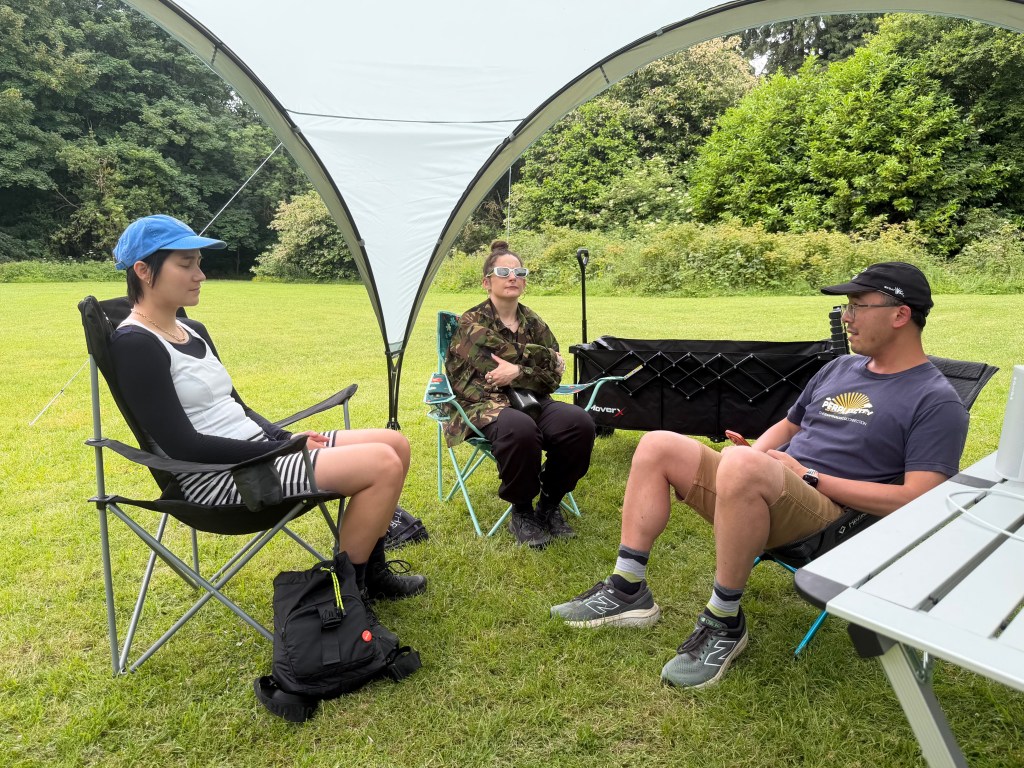
The same field test revealed a particular strand of gameplay was so engaging that players might quickly exhaust everything we’d planned. My answer was to write more story to support it, and to lean into a bit of “weird sci-fi” that would explain why it worked in the way it did (and frankly, to cover for our limited resources).
We never envisaged Strandfall as “hard sci-fi” in the first place, so I’m not sure why it didn’t occur to me to add in more mysterious or fantastical elements. A lot of our inspirations – Death Stranding, Battlestar Galactica, Eclipse – mix hard sci-fi with the inexplicable. Maybe I was unconsciously waiting for the right moment.
It feels natural to introduce weird elements into a form – larp – that relies so heavily on imagination. And as the everyday becomes science fiction, science fiction can feel mundane and predictable. Weirdness can remind us that not all is well, and that we should behave like it.
Casting
We received just under one hundred sign-ups to Strandfall in June – far more than our thirty-player capacity. Geographically, 55% were based in Edinburgh, 28% elsewhere in Scotland, and 14% elsewhere in the UK, leaving just 3% for the rest of Europe.
Experience-wise, about a third of people had played many larps, a fifth had played at least one, and another third had played tabletop role playing games but not larps; that left around 15% who had no TTRPG or larp experience.
Finally, most people were interested in walking, with a third of respondents preferring to jog and run, and the remainder opting for standing and sitting.
Bjarke Pedersen and Johanna Koljonen wrote, “everything is a designable surface” in larp, from character names and soundscape to the toilet temperature and website fonts. Casting, too, is part of design: we didn’t want all our players to be larp experts – new larpers have to come from somewhere – but we didn’t want to ignore the notion of “herd competency”, wherein larps fare better when there is some undefined critical mass of experienced players who can demonstrate to beginners Nordic larp’s ethos of “play to lift”.
So in the end, we aimed for 30-50% of players to have significant larp experience, and up to 20% to have zero TTRPG/larp experience. This is probably a much lower proportion of “experience” than in most Nordic larps, but a much higher proportion than almost any other kind of “traditional” participatory immersive art. It’ll be fascinating to see how it goes, and we’ll be sure to return to this question afterwards.
Expansions
Beyond the one hundred sign-ups, we’ve had lots of people asking to join a waitlist. I don’t want to think too hard about additional runs of Strandfall right now, but clearly we aren’t lacking in demand, in Edinburgh or beyond.
The core, unique technology of Strandfall is its fully-functional “storm sensor” devices: in theory, if you shipped a dozen to another park, you could run Strandfall there, too. Of course, it’s much more complicated than that. I’ll leave Alex to talk about the myriad technical considerations elsewhere, but the point of Strandfall is that you are briefly inhabiting another world.
This means, at the very least, a physical base of operations with a whiteboard and big maps and a thermal printer; a map and story that’s “site-sympathetic”; and a gameplay and duration that adapts to the size of the park and player numbers. Some of those things aren’t terribly difficult to do, and some could be accommodated by a sufficiently adaptable game design, but it’s hard to see how you could make the process of expanding to another park completely effortless.
So maybe you decide to do without the base of operations, and you swap the printed maps with digital maps and the paper messages with digital messages. Maybe you jettison the onboarding and workshops too, for accessibility’s sake; an optional digital tutorial is enough. Because it takes too long to physically walk around every park and adapt the sectors and story to new points of interest, you do it automatically based on Google Maps data. Eventually, you swap the storm sensor devices with a phone app. And so now the game has no unique physical component whatsoever; it’s entirely screen-based, making it deployable to any location to planet with zero friction. Some of the areas you’re instructing players to go to are, in fact, risky or impossible to reach.
There are genuine advantages to this. It’s much cheaper, for one. Between Zombies, Run! and Perplex City, I’m no stranger to making games with millions of players. But for Strandfall, this would be a loss.
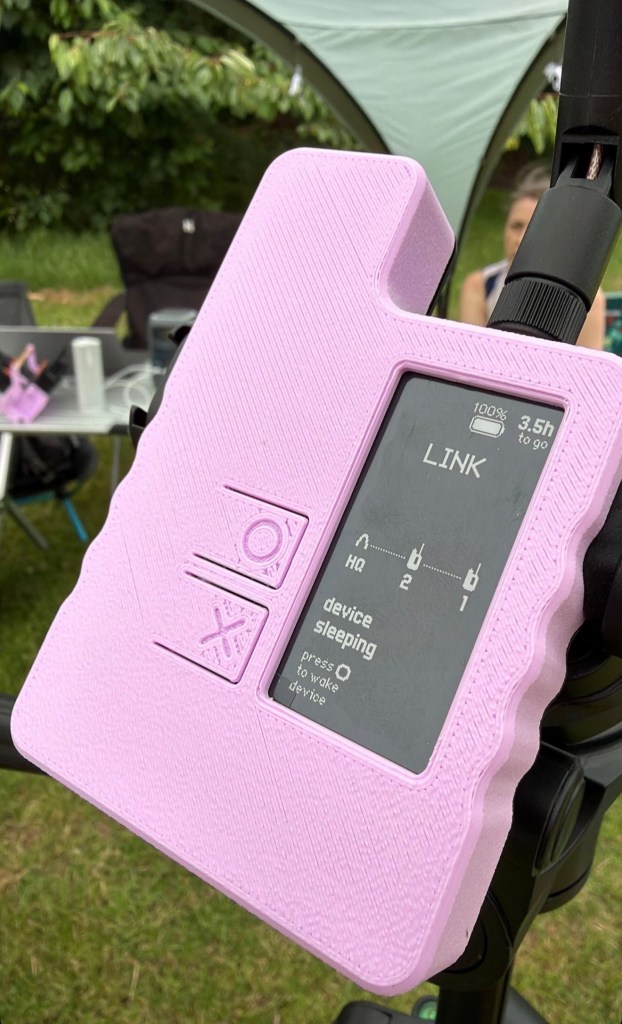
To flatten our face-to-face, retro-tech experience into one mediated purely by smartphone screens is to believe that the friction of multisensory experience is something to be overcome rather than celebrated. During our field test, people who were very familiar with Strandfall were nevertheless enchanted by our “McNair-Feldman” storm sensors, with their chunky antennae and muted ePaper displays. “These actually work?” they exclaimed.
They really did work. Not like smartphones, but like a device that had fallen through a portal from another world. In every way, these devices are specific to Strandfall. You wouldn’t make an identical device for an indoor-only larp, or a cyberpunk larp, or a space station larp. They’re literally hand-crafted, a wholly different expression of what technology can do for us beyond platforms controlled by trillion-dollar businesses.
The truth is, we don’t lack for entertainment and experiences that are massively scaled. One need only open up Pokémon Go for a polished location-based game. What we lack are social, embodied, tech-assisted experiences in which we can discern specificity and humanity. In The Society of the Spectacle, Guy Debord opposed the “social measurement of time” – homogenised, commodified, externally-controlled life – to:
a federation of independent times – a federation of playful and collective forms of irreversible time that are simultaneously present
And so, if Strandfall were to expand, it would not be by stretching it thin, but through federation, where it can be adapted and transformed by people who can put as much of themselves into it as Alex and I have.

Leave a Reply