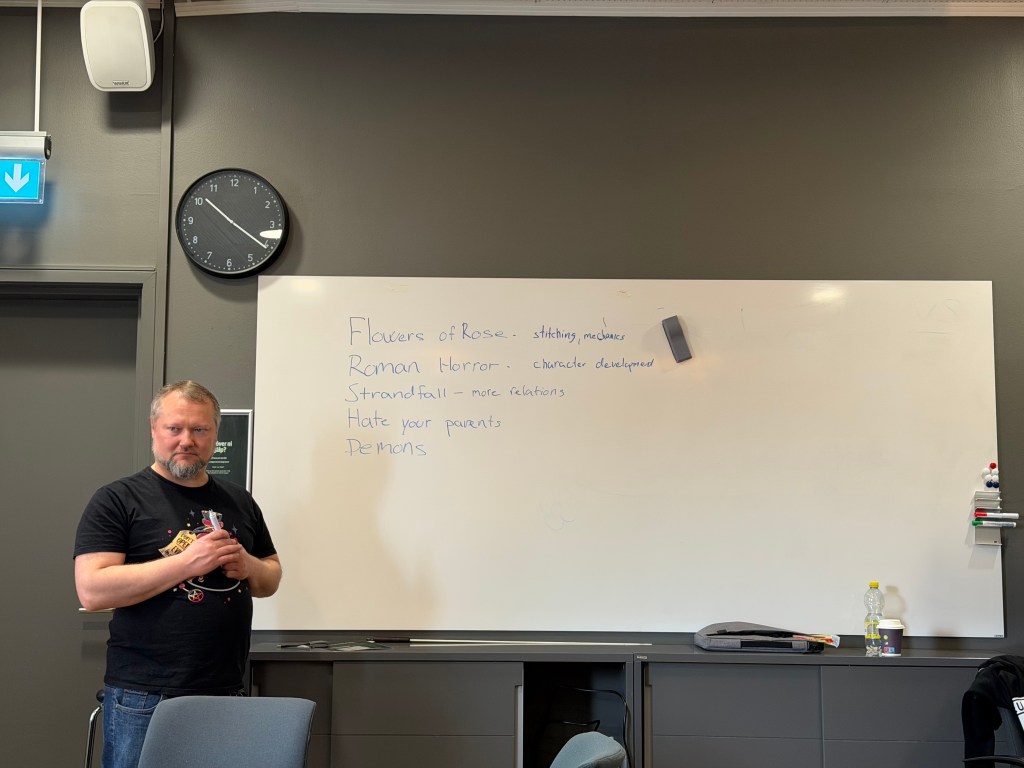
Every year, the Nordic Larp community holds a Knutpunkt (“nodal point”) conference that rotates between Sweden, Denmark, Finland, and Norway. Since Strandfall is a larp from the Nordic tradition – it has serious themes and requires players to collaborate rather than compete for attention and success – I was keen to see what we could learn from this year’s edition (read about my visit last year).
This year’s conference was held in Gothenburg, and it was a busy week for me: I gave three talks, on viewing the 2013 movie Austenland through a larp design lens; examining the critical backlash to participation; and how Russian theatre director Nikolai Evreinov’s idea of a “Theatre for Oneself” anticipated larp, which you can read for free in this year’s conference book.
Explaining Strandfall
I also spent a lot of time telling people about Strandfall. As everyone knows, there’s nothing better for refining an elevator pitch than doing it over and over again to strangers. What makes Knutpunkt attendees different, however, is that they already know and enjoy larp. Instead, I had to explain what made Strandfall distinct.
Because Strandfall is three hours long and will host up to thirty players, it’s similar in duration and size to chamber larp. However, most chamber larps take place indoors in a small space, and since they have limited budgets, they usually don’t involve much technology. By taking place across a much larger area and harnessing custom networked technology, Strandfall is more like a blockbuster larp, but those tend to be multi-day and have more elaborate costumes and scenography, which we lack.
It gets more complicated. Almost all larps are held in private spaces. Even when they’re outdoors, the public is usually kept away in order to preserve the illusion and avoid awkward questions and interruptions. Strandfall will be in a public park – not a busy one, to be sure, but we do expect members of the public to be around.
After a few rounds of explanations, I eventually settled on saying we were making a pervasive game, using the example of Pokémon Go for those who didn’t know the term. Alternate reality games like my own Perplex City have had pervasive game elements, and during the 2000s and 2010s, larps like Prosopopeia also experimented with the form. Not all pervasive games are larps, however – the vast majority of Pokémon Go players don’t role play as “actual” trainers.
Most attendees understood this straight away and were very intrigued by our custom “storm sensor” technology that Alex wrote about. So now, at least, I know how to talk about Strandfall to larpers.
Larp Design Workshop
During the conference, Jost L. Hansen organised a workshop where larp designers could get feedback from one another. I gave a brief overview of Strandfall and said I was concerned players might run out of things to talk about during the larp, given that we are planning to send players out in pairs for much of the three hours.
While Alex and I had already thought of some of the proposed ideas, and our larp consultant Juhana Pettersson had provided more, it was encouraging to hear experienced players and designers say we were heading in the right direction. Here are some of their suggestions:
- Make players to shelter during storms, and have 2-3 shelters to mix things up
- Require players to exchange information and tools to solve problems, so pairs must come together
- Give each player two prompt cards with things to talk about if they get bored
Jost also suggested that a three hour larp wasn’t long enough for players to run out of things to talk about, especially one with as much gameplay as Strandfall.
Most of the suggestions from the workshop were more sprawling, however. One person was reminded of a larp inspired by A Quiet Place (I forget the name, sadly); apparently, a player had to constantly monitor a screen to watch when radio waves changed to know when monsters were approaching. When this happened, they raised a flag on a tall pole to tell everyone outside. Another was reminded of the Stalker movie and games, and suggested we have an exclusion zone in the park that players can’t enter at first.
By coincidence, everyone in the workshop had played the blockbuster sci-fi larp Eclipse. Even more amazingly, everyone had been on the Explorer team, which was a major influence on Strandfall. A couple of people were excited that our storm sensors were more “functional” and “gamified” than Eclipse’s, since they might introduce more time pressure and danger.
I was very relieved by this. Many Nordic larps, out of necessity or design, lack technologically gamified systems, and I was concerned that Strandfall might seem too mechanical to some. But perhaps I shouldn’t have been worried – both Eclipse and Odysseus had lot of technology and systems for players to navigate, and no-one seemed to mind them since they made since within the sci-fi fiction. Similarly, we represent Strandfall’s post-apocalyptic storm sensors diegetically: we are getting players to do what their characters “really” would do with “real” technology, in the hopes it will produce a uniquely powerful experience that will aid immersion into character. That’s the theory, anyway!
As much as we’ve learned from Nordic larp, I’m hoping we can contribute our own experiences back eventually, both on this blog and at conferences. We’re already planning knowledge-sharing calls with veteran designers who are keen to learn about our technology. After all, both Nordic larp and Strandfall are about community.


Leave a comment