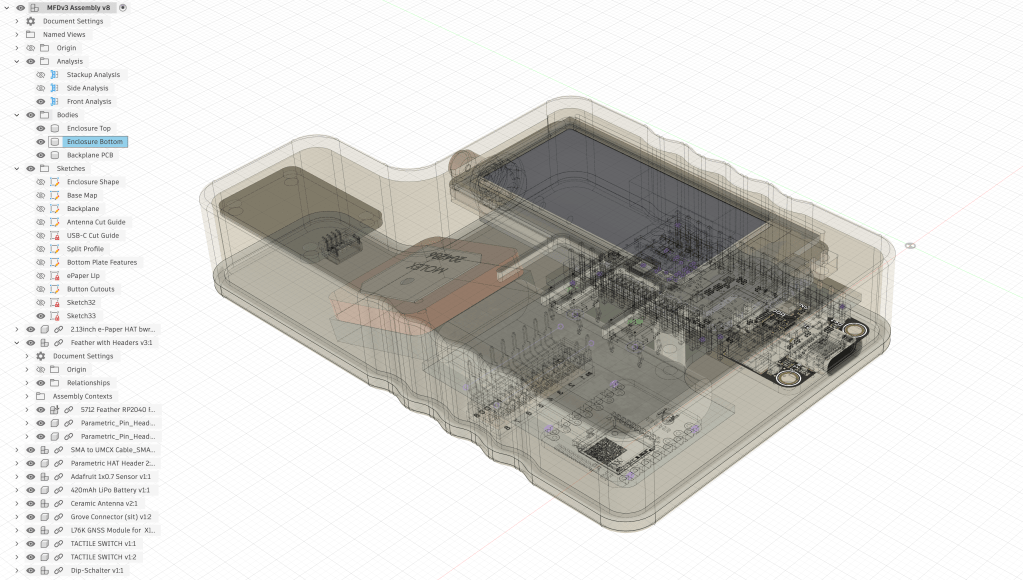
In the fictional world of Strandfall, the “McNair-Feldman Device” (or MFD for short) is the technological breakthrough that makes the expedition possible — a handheld and tripod-mountable device housing a cutting-edge sensor that, if deployed effectively, will unlock the secrets of Strandfall’s dangerous storms.
Many larps incorporate doohickeys and gadgets that perform science-fictional and/or fantastical functions, such as the Mindlink device in Eclipse, or the Consciousness Transfer Device in Greylight. In such larps, it’s through roleplay that participants collaboratively imagine and perform the supposed function of the device.
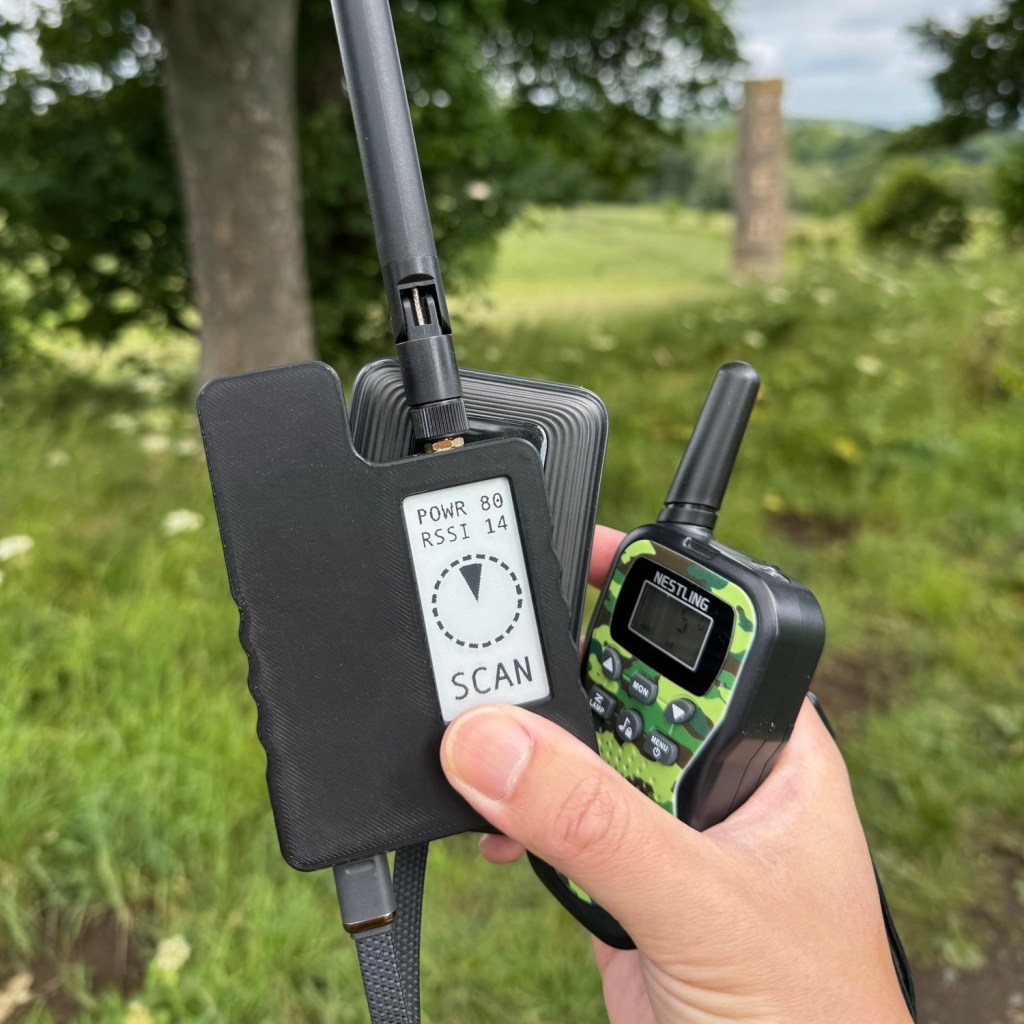
In Strandfall, our MFDs are true “spatial computers”, incorporating batteries, radios and real sensor hardware so that they meaningfully respond to what our participants do with them. They can be used correctly and incorrectly. They can break and be fixed. They can be stationed, configured, hacked, charged, shaken, oriented, rebooted and interlinked.
Components
Given our open development approach to this project, I won’t spare the technical details when it comes to the components we’ve incorporated into the MFDv3. Feel free to skip ahead if you feel your eyes unfocusing on all of this.
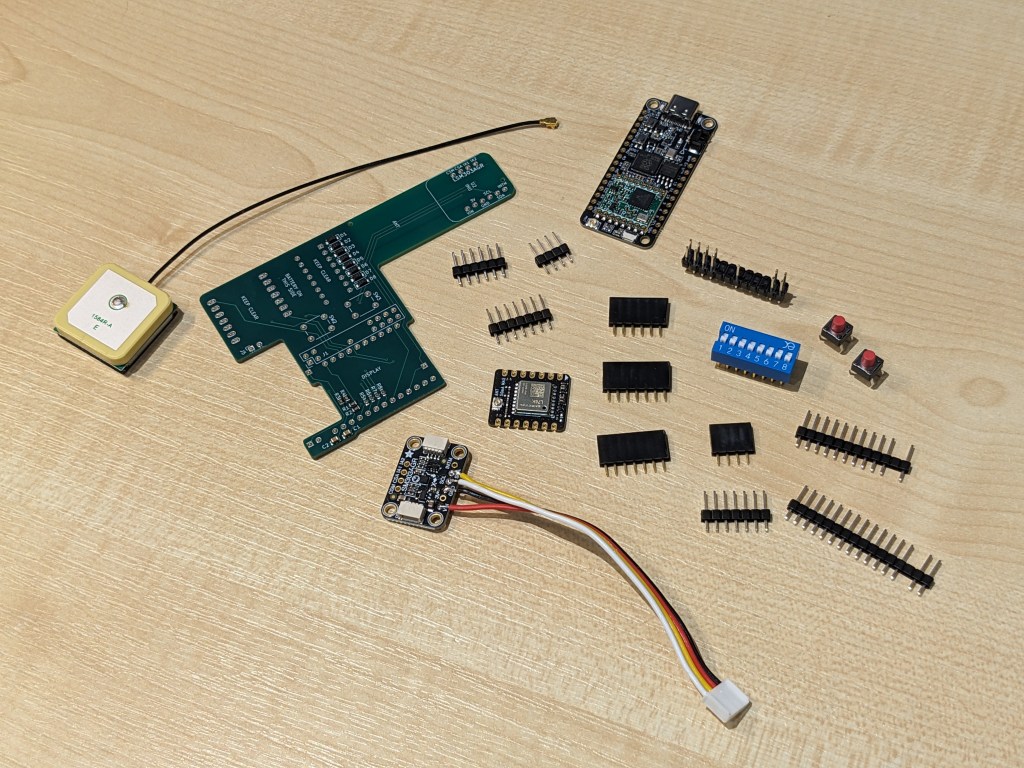
- A Challenger RP2040 LoRa “embedded computer” gives us a Raspberry Pi Pico microcontroller, a battery charge controller and a LoRa radio for long distance, low power networking.
- A Quectel L76K GPS radio tells us where the device is located in the play area (or indeed anywhere in the world).
- An STMicroelectronics LSM303AGR gives us an accelerometer and magnetometer, so we know when the device is moved, and we know which way it’s facing with respect to magnetic north.
- A Waveshare 2.13in ePaper display displays graphics and text in black and white while looking great in bright daylight.
- A 420mAh LiPo battery powers the device for approximately four hours on a single charge. Our design includes a self-resetting fuse as protection against shorts to ground.
- We also throw in two buttons for simple input, and a set of eight “DIP” switches that can be toggled with the help of a ballpoint pen for … fun. Because DIP switches are cool.
- All of the above components are soldered to our custom PCB and packaged in a 3D-printed enclosure.
Capabilities
As you may have guessed, the name “MFD” originates from “Multifunction Device”, since the platform that we’ve built is quite generic in design. My code repository for the project is still called /gpdfwg/ — “General Purpose Device for Wide Games”.
With generality comes a lot of freedom to change our minds about the way players interact with the devices in the final Strandfall design. The list below, then, is not the definitive list of things you’ll do when you join Strandfall’s exploration team. It’s only the ideas we’ve had so far, to develop or discard as we progress.
You can:
- Set the MFD on a tripod in a location of interest within the park, and orient it to scan a particular object or landmark.
- Use the buttons on the MFD to configure the scanning mode, perhaps wide-angle to cover a large area, or narrow for higher sensitivity.
- Review the results of the scan on the MFD’s screen, and record a scanning result code that can be taken back to headquarters to access the full report.
- Set up an MFD in sentry mode to continuously monitor an area for anomalies.
- Deploy a network of MFDs, all in range of one another, to monitor the entire park from a central location.
- Sprint through a storm while carrying the device to collect valuable data on the storm while minimising your own exposure.
- Plug in additional devices to the USB-C port to augment the MFD’s sensor capabilities, download findings, or calibrate the Feldman sensor to detect a new kind of anomaly.
- Flip through the MFD manual, hastily-assembled by McNair herself, to try to understand what configuration of switches will configure the MFDs so that communications aren’t so easily disrupted by storm activity.
Progress Report
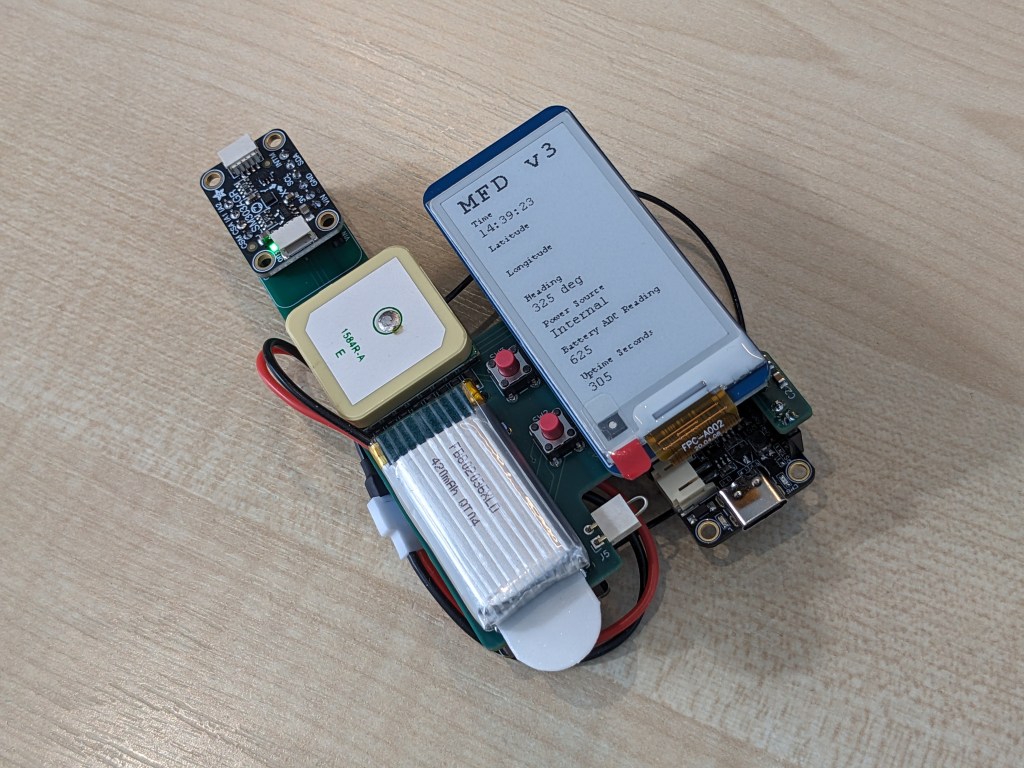
The “V3R2” PCB is the fourth that I’ve designed for this project so far, and fingers crossed, it’s the last.
I recently finished evaluating V3R2 (shown assembled above) and confirmed that the microcontroller, display, battery, LoRa radio, GPS radio, accelerometer, magnetometer, buttons, DIP switch multiplexer, USB voltage divider and battery voltage divider are all working as intended.
Next, I’ll be updating the enclosure design for the new internal layout, and testing the device’s behaviour on foot around my local neighbourhood.
Further out, we’re preparing for possible demos in May and “field testing” in June, where we’ll take fully-assembled devices and other necessary hardware for a complete deployment to Cammo Estate in Edinburgh and put it all through its paces. This will also be an opportunity for us to soft-test Strandfall’s fictional and social design.
Watch This Space
I’ll write more posts in the coming weeks and months about the progress of the technical side of this project, as well as recaps of the many things we already learned bringing the McNair-Feldman Device to life.

Leave a comment