Strandfall draws its influences from a wide range of art: larp, video games, TV shows, movies, and more. This is a series of blog posts exploring them:
Death Stranding
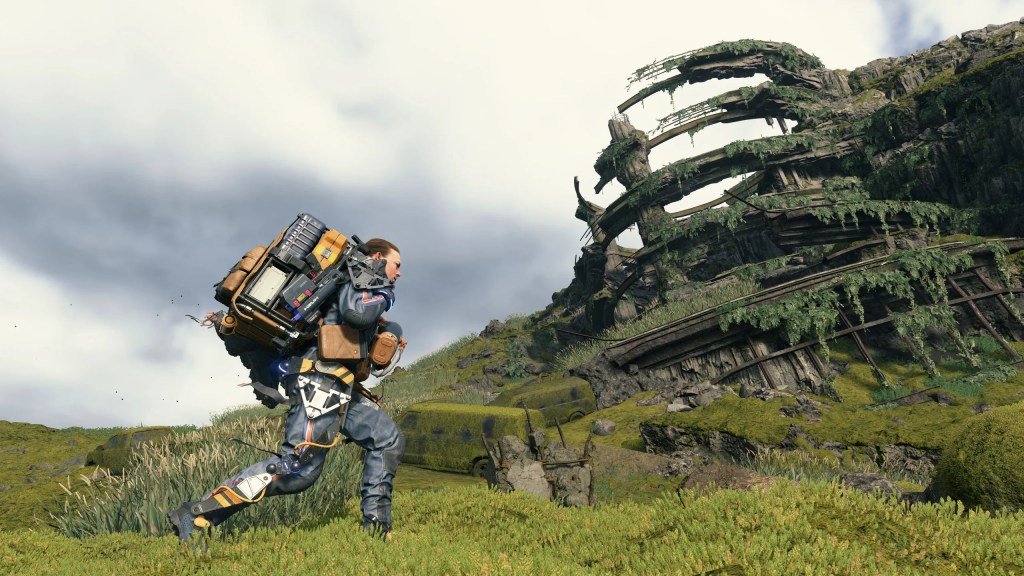
Death Stranding is a 2019 video game where you traverse a post-apocalyptic North America, carrying supplies and cargo between isolated settlements in order to reconnect humanity.
The story is quite convoluted and, to be honest, I didn’t get very far in the game, but I have never felt a stronger sense of bone-tiredness than when I was trying to ford a river while carrying far too many packages. Death Stranding has an unusually detailed simulation of the physics of human movement; if you try to walk too quickly or carry an unbalanced load, you’re liable to fall and scatter whatever you were carrying, as happened to me several times during my fording attempt.
As such, it’s very different from most action adventure games that revel in speedy movement, unimpeded by weight or weariness or obstacles. In Death Stranding, one approaches a cliff with trepidation and estimation, tracing its lines for a safe way up. Thanks to its asynchronous pro-social multiplayer system, that way might be smoothed by a handy ladder left by another player.
Death Stranding isn’t the only game to consider the frailties of ambulation. Since the early 2010s, Bennett Foddy‘s games like QWOP and GIRP exposed its complexities, and his most recent game Baby Steps was itself inspired by Death Stranding.
Players in Strandfall will have the opportunity to do a lot of movement around a lively open world environment in the form of the real world. We want them to think about the best way up a hill; the right spot to mount a sensor in a copse of trees; the pleasure of sprinting down a well-trodden path. We want them to swap tips about where to walk and run, how best to secure a tripod on your back. We want them to think about their bodies and the land.
Eclipse
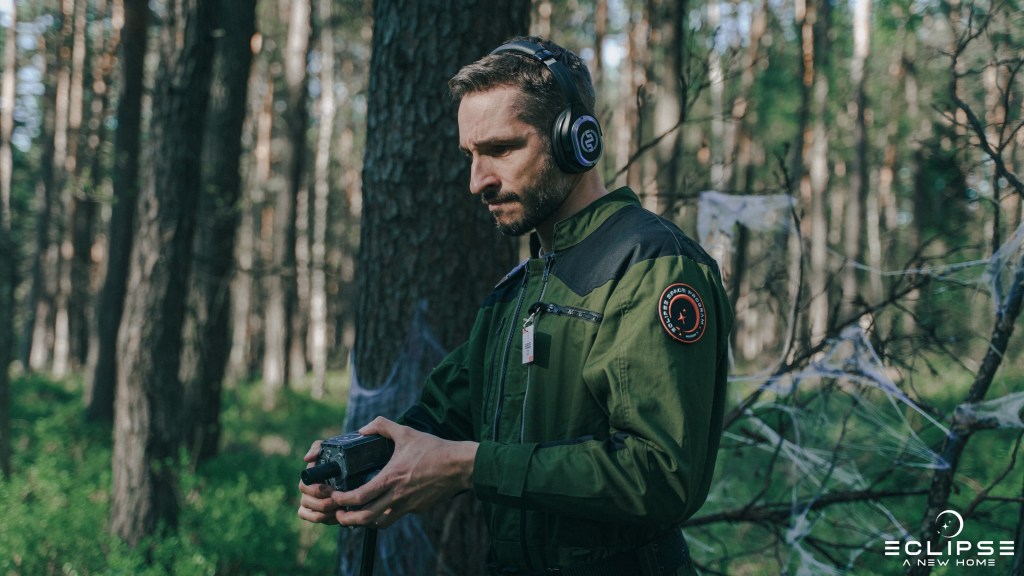
I am fairly sure we came up with the idea of Strandfall’s “storm sensors” after playing Chaos League’s 2025 larp Eclipse.
Eclipse is a three-day sci-fi larp set in 2059. Earth has been wracked by environmental disasters, leading to widespread civil war. Humanity’s hopes lie in the Eclipse space programme, established to find a new home using wormhole technology. When the larp begins, all 150 players are in a base on Gliese 628A, one of seven candidate planets for colonisation. The three days take place in real time as the base initiates first contact with aliens.
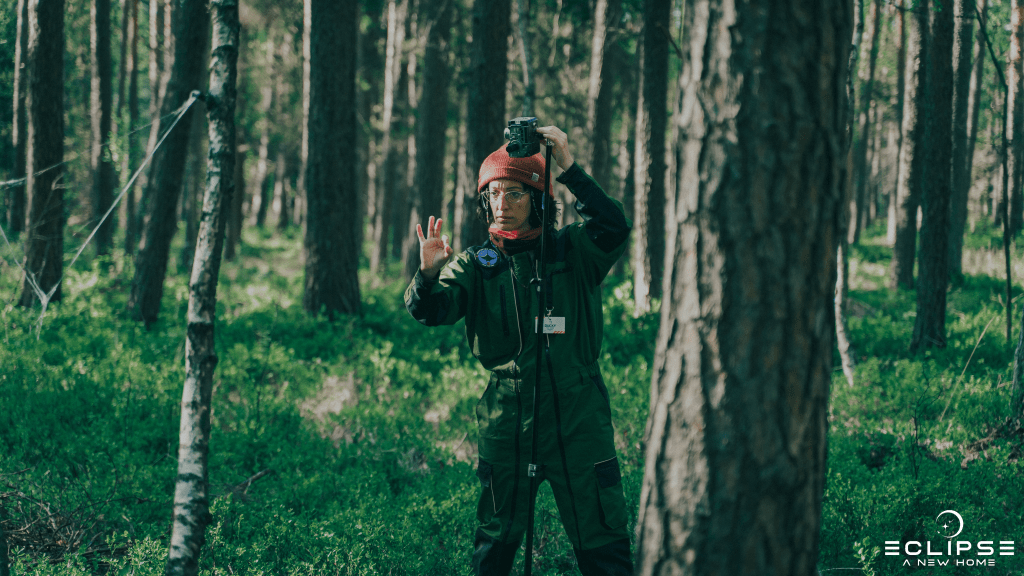
I’d opted to play as an Explorer, which meant I went out with my team to survey sites with high-tech sensors. During a typical expedition, we might set up four lasers on tripods around the perimeter of a site to “scan” it, or place flashing LED devices in a grid. In practice, the “sensors” were LEDs and lasers housed in 3D-printed units – and nothing else. This meant there was no automated process to verify whether we’d placed the sensors correctly. Instead, it was up to players to collectively decide, through their role play, whether a deployment was successful or not.
Despite (or perhaps thanks to) this limitation, I found Explorers’ surveyor-like gameplay to be atmospheric and pleasingly tactile. We weren’t poking at touchscreens or driving drones, but lugging tripods around a forest and struggling to set them up amid dense undergrowth.
There are a couple of advantages to Eclipse’s lo-fi design. Firstly, it’s a lot faster and cheaper to trust players to play along rather than make a genuinely functional sensor which might end up breaking (as, indeed, our laser units often did). Secondly, it dissuades players from trying to game or cheat the process in order to “win” by deploying sensors as fast as they can. Thirdly, it delivers the desired aesthetic of looking and feeling suitably scientific without introducing a potentially difficult skill to learn.
At the same time, there are downsides. Non-functional sensors means players lose out on the feeling of learning and mastering a skill, and they make it harder to deliver new gameplay-dependent information to players in real time; during Eclipse, we had to wait until we returned to our base before we found out the results of what we’d found. Genuinely functional sensors can also impose interesting physical constraints on players.
Strandfall is an experiment about what happens if we introduce highly functional sensors – our custom “spatial computers” – into a larp. How can we design the experience so that players don’t fixate on the need to “win” at deploying the sensors better than others? And how can we use their ability to reveal information to players in real time while keeping room for players to talk and engage with one another directly?
(Here’s my account of playing Eclipse)
PUBG: Battlegrounds
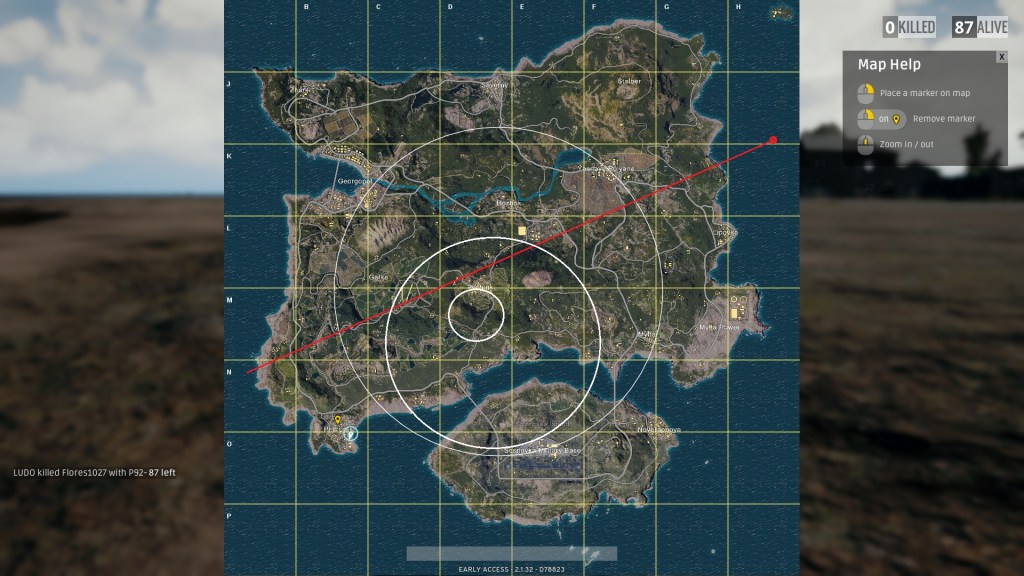
PUBG is a “battle royale” video game where one hundred players compete to be the last person standing. Inspired by the movie Battle Royale, players are herded into increasingly smaller circular play areas over time; in Fortnite, another battle royale game, the area outside the circle is a deadly storm.
When I played PUBG shortly after its release, I was struck by the inherent drama of an unpredictably shrinking play area that forces players to be on the move and run into enemies. Apparently this gameplay mechanic is used in some airsoft and paintball communities using apps like Ares Alpha and BTTLMPS, though I’m not sure how popular it is.
Strandfall isn’t designed to be competitive and much of the larp will require a lot of co-operation. Still, we want it to feel dramatic and risky, and unpredictable storms feel very generative: threats to predict, dangers to escape, and under the safety of shelter, moments to reflect and connect.

Leave a comment